
The Indian manufacturing SME runs on more software than it realises. There is Tally for finance, a spreadsheet for the bill of materials, a WhatsApp group for the shop floor, a separate portal for GST e-invoicing, an email thread for the e-way bill, a notebook on the supervisor's table for actual production output, and a fourth system somebody set up in 2019 to track scrap. None of them talk to each other. All of them are right, some of the time.
This is the gap a manufacturing ERP in India is supposed to close. After building custom manufacturing ERP for automotive component makers, food processors, textile units and heavy fabrication shops, we will say plainly: most off-the-shelf manufacturing ERPs close a fraction of it, and most listicles ranking the "Top 10 ERP software for Indian manufacturers" never tell you which fraction.
This post is the honest version. What a manufacturing ERP must actually do for a mid-market Indian factory, shop floor to GST, and why the answer for an increasing number of Indian SMEs is a system built specifically for the way they manufacture rather than a vendor's assumption of it.
The Indian manufacturing SME reality, in one paragraph
A typical Indian manufacturing SME we talk to has between 50 and 500 employees, between two and twelve product lines, a single plant or two adjacent ones, exports to one or two markets, an export incentive scheme they care about, GST filings they cannot get wrong, a labour-and-wages calculation that includes shift bonuses and overtime, a vendor master that has accumulated nine years of drift, and a shop-floor supervisor who knows production reality two days before any dashboard does. Any system you put in must respect all of this. Off-the-shelf manufacturing ERPs respect parts of it. The rest becomes the customisation tax that the next five years will quietly pay.
What a manufacturing ERP must do, shop floor side
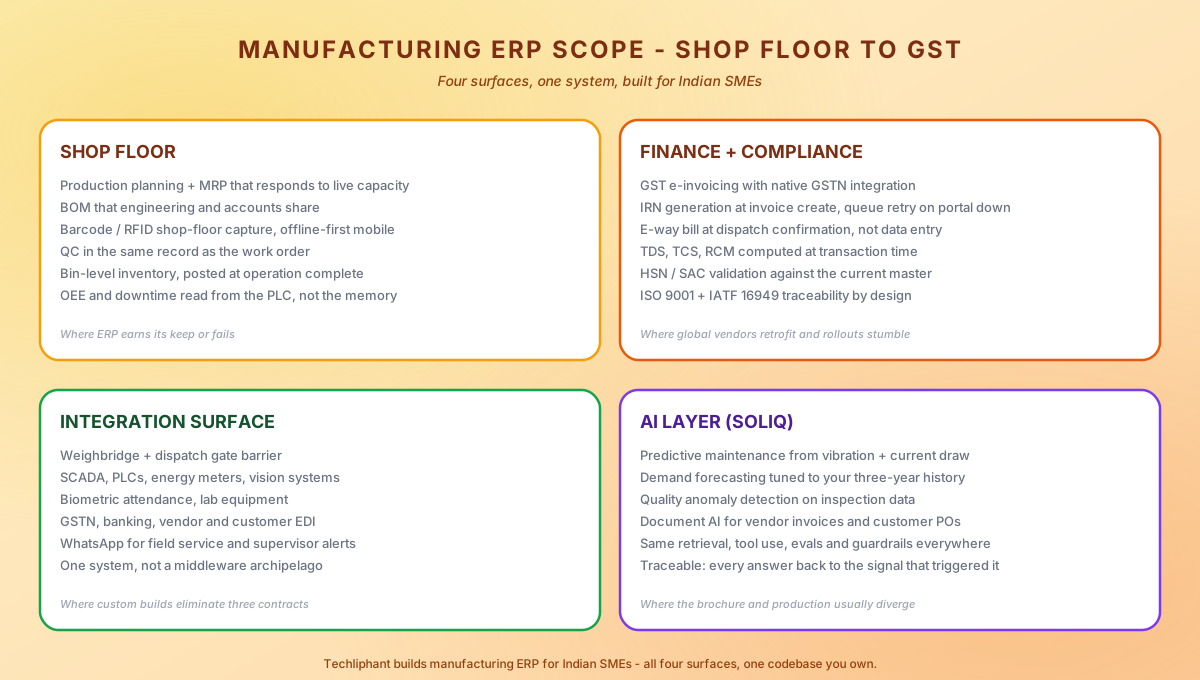
The shop floor is where the ERP earns its keep or fails. Six capabilities, all non-negotiable in every custom ERP we build for Indian manufacturers.
1. Production planning and scheduling that responds to reality
A production plan that takes thirty minutes to update is a production plan that nobody updates. The plant runs on a whiteboard, the ERP runs on yesterday's plan, and the variance gets explained at the monthly review.
What works in a custom build: a planning module that recomputes against live machine availability, live material status and live order priority in under a minute, with drag-and-drop adjustment that the planner can do without raising a ticket. What does not work: an MRP that assumes infinite capacity, recommends a perfect schedule, and breaks the moment a CNC machine throws a fault at 10:42 in the morning.
2. A bill of materials engineering and accounts can both live with
The BOM is the artefact most ERPs underestimate. Engineering wants every part, sub-assembly, alternative supplier and revision history. Accounts wants standard cost, landed cost, scrap allowance and a number that ties to the GL. A serious manufacturing ERP keeps both views over the same record, with version control on the engineering side and cost roll-up on the accounting side, and does not force one team to maintain a duplicate.
When we build, the BOM is the data model decision we make first. It dictates how MRP runs, how costing rolls up, how work orders dispatch and how QC plans attach. Get it right once and the rest of the system falls into place. Get it wrong and you are still arguing about it in year three.
3. Shop-floor data capture that does not depend on the supervisor remembering
This is the failure mode we see most often. Production output is captured at end-of-shift on paper, transcribed at end-of-day, entered into the ERP at end-of-week and reconciled at end-of-month. By the time the variance is visible, the cause is forgotten.
What we build instead: barcode or RFID scanning at the workstation, tablet-based job confirmation that takes the operator under fifteen seconds, automatic integration with the time-and-attendance system, and an offline-first mobile app for every shop floor where wifi dies near the heavy machinery. The supervisor logs in to a desktop only to review, never to enter.
4. Quality control as part of the flow, not a separate system
Inspection plans, in-process checks, final inspection, non-conformance reports, corrective and preventive actions, all of these belong in the same system that knows the work order, the operator, the machine and the batch. When QC lives in a separate spreadsheet, the link between defect rate and the machine-operator-shift combination disappears, and the root-cause analysis your ISO auditor expects becomes a forensic exercise.
5. Inventory accuracy at the bin level, not the warehouse level
"We have 4,200 of part number X" is not inventory accuracy. "We have 4,200 of part X, 1,800 in raw stores rack A3, 1,200 staged at line 2 work centre, 600 in WIP between operations 30 and 40, and 600 in the rework cage" is inventory accuracy. The difference is whether the planner can promise a delivery date without walking the floor.
A manufacturing ERP earns its place by tracking inventory at the bin and the operation, with consumption posted automatically against the work order at the moment the operation reports complete. Anything less is a financial inventory system, not an operational one. Custom development lets us put this data model in from day one rather than retrofitting it on top of a vendor's idea of a warehouse.
6. OEE and downtime, captured automatically where it can be
Overall equipment effectiveness is the most quoted, least measured number in Indian SME manufacturing. The reason is simple: capturing downtime manually requires a supervisor to remember the start time, end time and reason code for every stoppage during a shift that already has them running between four machines.
In every custom manufacturing ERP we ship, we integrate with the PLCs on the machines that support it, capture downtime automatically by reading the run-stop signal, and prompt the operator only for the reason code. The numbers are then real, not aspirational, and the conversations they enable, predictive maintenance, capacity planning, capital expenditure justification, stop being arguments about whose data is right.
What a manufacturing ERP must do, finance and compliance side
Indian manufacturing has a compliance layer no global ERP vendor designs for. They retrofit it. The retrofit is where most rollouts run into trouble.
GST e-invoicing that does not break at threshold transitions
The GST e-invoicing threshold has moved repeatedly since 2020, most recently down to a turnover bar that now covers most mid-market manufacturers. Every manufacturer we talk to has at least one story of an invoice that went out without an IRN, was rejected at the customer's accounts payable, and held up a payment for three weeks. The ERP's job is to make this impossible: IRN generation at the moment of invoice creation, automatic fallback if the GSTN portal is down, and queue management that retries cleanly when the portal recovers.
What we build into every custom manufacturing ERP: native GSTN integration, not a third-party plug-in; HSN and SAC code validation against the current master; rate determination that handles inter-state, intra-state, SEZ and export scenarios without manual override; and an audit trail an auditor can walk through without our help.
E-way bill generation tied to dispatch, not to data entry
The e-way bill is generated at the moment the goods leave the factory, not at the moment somebody has time to enter it. A serious manufacturing ERP generates the e-way bill at dispatch confirmation, embeds the vehicle number and driver detail at the gate, and consolidates the bills for multi-drop loads automatically. Anything else is a queue of pending compliance.
TDS, TCS, RCM and the rest of the alphabet
Tax deducted at source, tax collected at source, reverse charge mechanism: the Indian compliance surface for a manufacturer is non-trivial, and the cost of getting it wrong is a notice the CFO has to answer. The ERP must compute these at transaction time, not at month-end, and must allow the finance team to override with audit trail when the law requires interpretation.
ISO 9001 and IATF 16949 traceability, by design
Most Indian SME manufacturers we work with carry ISO 9001 certification, often alongside customer-specific standards like IATF 16949 for automotive components. The audit asks one question repeatedly: show me the record. Show me the inspection record for batch 2024-11-A-447. Show me the operator certification for the welder who ran job 88231. Show me the corrective action that closed non-conformance NCR-2024-19.
A manufacturing ERP that treats traceability as a feature you bolt on later is a manufacturing ERP that turns every audit into a project. Traceability belongs in the data model from day one, which is precisely the advantage of a custom-built ERP for manufacturing over a configured packaged one.
**See how we build manufacturing ERP for Indian SMEs →**
The integration nobody puts on the brochure
A manufacturing ERP in India does not live alone. It lives next to the weighbridge, the SCADA system, the PLCs on the line, the energy meters, the biometric attendance terminal, the chemical analysis lab equipment, the dispatch gate barrier, the GST portal, the bank for vendor payments, the customer's EDI portal, and increasingly the WhatsApp group the field service team actually uses.
Most off-the-shelf ERPs handle the marquee integrations, GST, banking, sometimes EDI, and treat everything else as out of scope. The result is a middleware layer the IT team builds and maintains, sometimes well, sometimes as a sequence of cron jobs nobody documented.
A custom-built manufacturing ERP puts the records, the workflows and the integrations in the same system. The win is not the ERP. The win is the elimination of three integration contracts, the disappearance of two reconciliation reports, and the supervisor seeing the weighbridge ticket on the same screen as the work order it belongs to.
The framework we use to decide between custom and packaged turns on five factors: specificity of process, total cost of ownership over five years, integration surface area, compliance and data residency, and speed to value. The same five factors apply whether we are scoping a custom CRM, a custom ERP or a bespoke internal platform.
The AI layer most ERP vendors skip
This is where manufacturing ERP, as a category, is moving fastest, and where the gap between what is on the brochure and what runs in production is widest.
The genuine value of AI in a manufacturing ERP shows up in four places.
Predictive maintenance. Read the vibration, temperature and current draw signatures from the line, model the failure curve for each critical machine, and surface a maintenance task before the machine fails rather than after. The downtime avoided pays for the model in months. The hard part is the data plumbing, not the model.
Demand forecasting tuned to your history. Generic demand forecasting models miss the seasonality, the festival effect, the promotional cycle and the export-shipment lumpiness an Indian SME manufacturer lives with. A model trained on your last three years of order history, your dispatch records and your inventory turns will beat a generic forecast by a wide margin. The savings show up in raw-material carrying cost.
Quality anomaly detection. Vision models on the inspection station that flag defects the operator misses on shift seven. Statistical models on the QC data that flag a drift in cylinder bore tolerance before the rejected batch reaches the customer.
Document AI for vendor invoices and customer purchase orders. Most SME manufacturers spend more time on accounts payable data entry than they care to admit. A grounded extraction model on PO and invoice formats removes most of it.
The reason most off-the-shelf ERPs ship AI badly is that they treat it as a feature, not as a layer. Tilarq AI, the engine we built to power AI inside our own products, takes the layer approach: one place for retrieval, one place for tool use, one place for evals, one place for guardrails. When we build a custom manufacturing ERP, Tilarq AI goes in alongside it. The ERP module asks Tilarq AI for an answer; Tilarq AI routes the request to the right model, grounds it on the right corpus, applies the right guardrail, and logs every step for audit.
This is the difference between "the ERP has a chatbot" and "the planner gets a maintenance recommendation, on the same screen as the work order, with the underlying signal traceable back to the sensor that triggered it". The first is a demo. The second is a tool you run a plant on.
When custom manufacturing ERP wins for Indian SMEs
Off-the-shelf works for some manufacturers. We say so on the first call. If your process is genuinely standard, if you are below about fifty seats, if your integration surface is small, and if you do not have a regulated data requirement that vendor licensing cannot accommodate, configure a packaged ERP well and do not customise the core.
For everyone else, custom is the more honest answer over five years. The pattern we see, every week:
- Specific process. Your sales motion, production motion, or compliance motion has at least three quirks the packaged ERP cannot configure to. Every quarter you spend bending the package toward your motion is a quarter you do not get back.
- Integration debt. The OT stack on your shop floor, the weighbridge or SCADA or PLC or vision system, will not integrate cleanly with a vendor whose marketplace was designed for North American discrete manufacturing.
- Regulated data and export obligations. Customer-specific compliance, data residency for export markets, or sector regulators that ask for things the vendor will not sign for.
- Five-year ownership horizon. You want to own the IP, control the roadmap, and not pay per-seat escalations as headcount grows.
- Already broken one packaged ERP. You are not on your first attempt. The system you have is the workaround. You know exactly which assumptions of the package broke against your reality.
If any two of these are true for you, the math on custom usually wins. Talk to us and we will run the framework against your specifics.
Implementation realities for a custom build
Most failures in Indian manufacturing ERP rollouts are not technical. They are about phasing, data, training and sponsorship. The seven failure modes we have seen most often, big-bang go-lives, configuring around broken process, underestimating data migration, no executive sponsor with decision authority, training treated as a pre-go-live event, reports built after the modules are live, and underestimated hypercare, all show up in the custom ERP engagements we run, and all are avoidable. A few specific notes for the custom manufacturing context.
Phase by module, never big-bang. Finance and core inventory first, manufacturing and procurement next, advanced QC and analytics last. Every phase is a go-live event with a cutover checklist and a rollback procedure. Custom development buys you the freedom to phase exactly how your operations can absorb the change, instead of accepting a vendor's pre-set deployment template.
Budget more for data migration than you think. The item master is always dirtier than the audit said. The vendor master has duplicates. The opening WIP balance is somewhere between three systems. Cleanse before you migrate, regardless of platform.
Train role by role, not module by module. The shop-floor operator does not need to know the GL. The accounts clerk does not need to know work-order routing. Two pages of runbook for each role beats a 200-slide deck every time. In a custom build, the role-based interfaces are designed for exactly the workflow the role runs, which makes the training material shorter, not longer.
Plan for sixty days of hypercare, staffed by the people who built the system. The first month-end close, the first GSTR-1 filing, the first export shipment under the new system, these are when reality enters. Be there. When we build, the engineers who shipped each module are the same people on the floor for hypercare. No separate support desk reading tickets cold.
The single test that ends the conversation
The line we use with every manufacturer we evaluate with: if we built this system exactly as your current process describes, in the technology stack you can afford to maintain, would it be visibly better than what your team uses today?
If yes, your problem is configuration on whatever you have, not a new ERP. Go fix the configuration. You do not need us.
If no, the ERP is enshrining a process nobody believes in. That is not the ERP's fault, but it is the next ERP's job to absorb the fix. A custom-built manufacturing ERP absorbs that fix at the data-model level rather than as a configuration workaround, which is why for the manufacturers in our portfolio it ends up cheaper, more reliable and easier to evolve than the packaged option over five years.
When you are ready to have that conversation against your actual shop floor, your actual GST volume and your actual integration list, talk to us. Bring your current ERP's pain points, your top three supervisor complaints, and one workflow you have wanted to redesign for two years. We will walk the framework against your numbers in under an hour, and we will tell you honestly whether you should build, configure or stay.